Modular home companies Indian Land, SC buyers call most often aren't actually headquartered in the ZIP code. They're a short drive away in Lancaster, Rock Hill, or York. That's not a drawback: you get the same licensed builders, the same statewide modular code, and the same financing rules as anywhere else in the Charlotte region, plus one state-level buying rule almost nobody mentions until a buyer gets burned by it.
Top Modular Home Companies Serving Indian Land, SC
Most Indian Land buyers pull from the same short list of companies, since that's the practical radius for delivery trucks and site crews. Here's how the main players stack up before you dig into the details below.
| Builder | SC base | Product type | Rough price signal |
|---|---|---|---|
| Carolina Country Homes | Lancaster, SC | Off-frame modular, multiple manufacturer partners | Mid-$200,000s and up, model-dependent |
| Clayton Homes | Rock Hill, SC and statewide | Manufactured (HUD code) and CrossMod | Varies by lot and model |
| Royal Homes | Family-owned, standard floor plan catalog | Modular | Mid-range, plan-dependent |
| Dvele | Ships nationwide | Premium modular, smart-home standard | Roughly $200 to $275 per sq ft |
Carolina Country Homes
Carolina Country Homes is the closest true modular dealer to Indian Land itself. Started in 1998, the company established itself as one of the premier installers of high-quality modular homes across South Carolina and the Metrolina region of North Carolina. It works with multiple manufacturer partners rather than one factory line, which gives buyers more flexibility on floor plans and finish levels than a single-brand dealer.
Clayton Homes
Clayton is the volume leader in South Carolina's factory-built housing market, with a retail center in Rock Hill. Its CrossMod line gets marketed alongside modular homes, but it's worth knowing the fine print. CrossMod homes are factory-built to federal HUD Code standards but designed with features that make them look and function like traditional site-built houses . They are not modular. CrossMod should not be confused with "modular" homes built to meet a specific local building code. The financing upside is real, though: Fannie Mae calls its program MH Advantage; Freddie Mac calls its program CHOICEHome , both of which let qualifying CrossMod buyers get conventional 30-year terms. Confirm which product line a given Clayton model actually falls under before you assume modular rules apply.
Royal Homes
Royal Homes is a family-owned builder with a deep catalog of standard floor plans rather than a narrow custom lineup. That breadth tends to appeal to buyers who want proven designs and predictable costs over heavily customized builds.
Dvele
Dvele sits at the premium end, built around smart-home systems and high-performance insulation as standard features. Dvele's prices are for the finished modules, including electrical, plumbing, mechanical systems, finishes, fixtures and appliances, at roughly $200 to $275 per square foot , before delivery, site work, and foundation. That's a real premium over the other three builders, but the trade-off is a tighter, factory-controlled building envelope.
The State Rule Most Modular Buyers Never Hear About
Here's the part most builder-comparison pages skip entirely. South Carolina is unique in its requirements for the sale of modular buildings. Out of state dealers or third parties are not licensed to sell modular buildings to be placed in South Carolina. Every modular unit set in Indian Land has to move through a South Carolina-licensed manufacturer or dealer, no exceptions.
It gets better for buyers. Consumers may buy directly from a modular building manufacturer, and if requested, S.C. law requires the company to sell its product directly to the consumer , cutting out a third-party markup. Few shoppers know to even ask. If a dealer refuses that request, the South Carolina Building Codes Council handles complaints against the manufacturer and its representative.
Modular vs. Manufactured Homes in South Carolina
The confusion between modular and manufactured homes drives nearly every financing headache buyers run into. A mobile/manufactured home is not a modular home , according to the SC DMV, which titles manufactured homes like vehicles until they're de-titled onto owned land. A modular home never gets a DMV title at all; it's real property from the day it's set.
| Modular home | Manufactured home | |
|---|---|---|
| Code |
South Carolina version of the 2018 International Residential Code, in effect since January 2020
| Federal HUD Code | ||
|---|---|---|
| Title | Real property at installation | SC DMV title until de-titled |
| Inspection | Local building inspector, same as site-built | Factory-certified HUD label |
| Financing | Conventional, FHA, VA, USDA | Chattel loan unless de-titled |
Roughly 19% of the homes in South Carolina are manufactured houses , and the SC Manufactured Housing Board, a division of the SC Department of Labor, Licensing and Regulation, enforces the rules dealers, installers, and contractors must follow for both categories.
How Much Does a Modular Home Cost Near Indian Land, SC?
Pricing swings hard based on lot condition, builder, and how far the site sits from paved roads and utilities. In our own site visits around Indian Land and the Rock Hill corridor, the biggest cost swing usually isn't the home package itself. It's whether the lot already has a cleared, graded pad or needs full site preparation before the modules can even be set.
A few reference points worth knowing:
- Statewide context:
U.S. Census Bureau data show the median price per square foot for new homes sold in 2023 by region: South ($146.64); Midwest ($156.25); Northeast ($220.95); West ($195.38) , for comparison against site-built pricing.
- Modular base price: Entry-level ranch models from builders like Carolina Country Homes tend to start in the mid-$200,000s before land and site work.
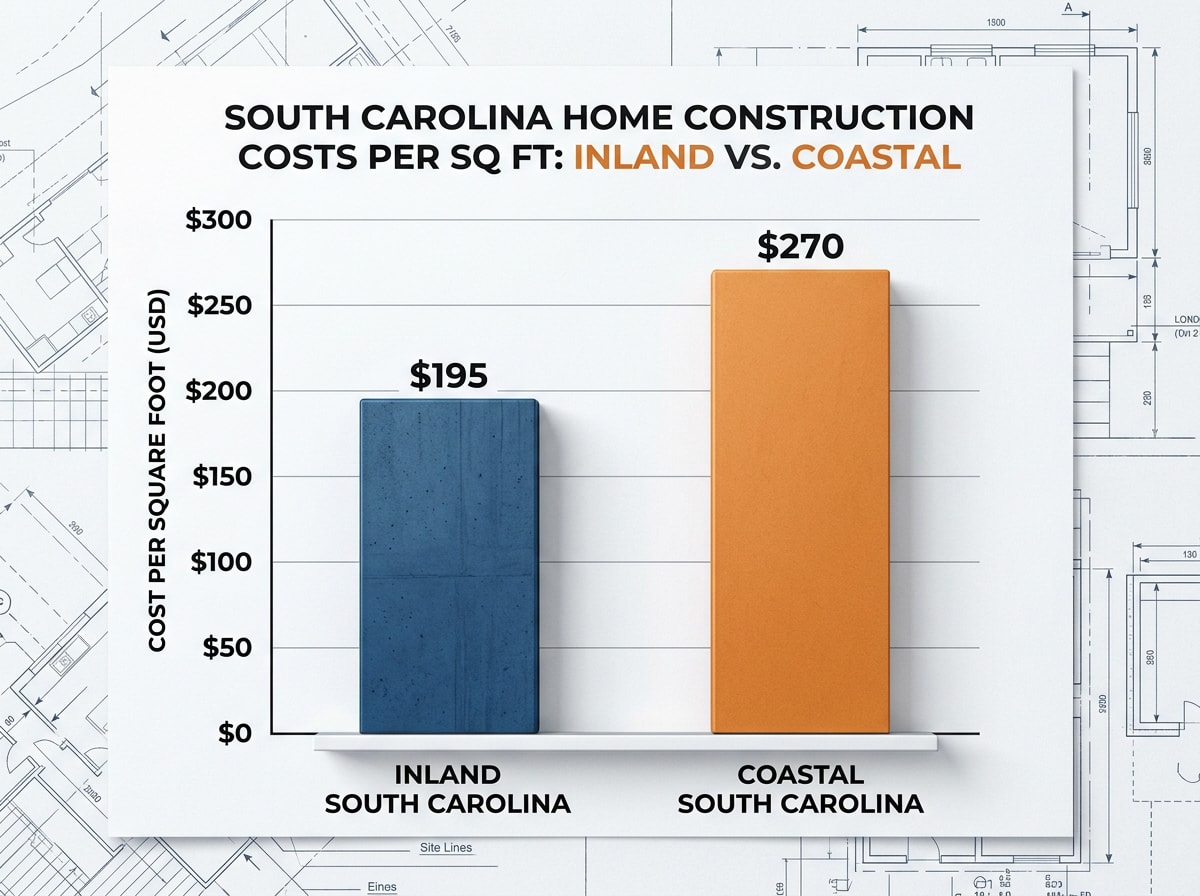
- Coastal vs. inland: Lancaster and York county sites generally face less demanding wind-load engineering than the Lowcountry, which can trim costs on the structural side, though every lot still needs its own site survey.
- Hidden cost driver: Well, septic, grading, and driveway access often move the final number more than the home package does.
When a Modular Home Isn't the Right Fit
Modular makes sense for buyers who want a proven floor plan and a tighter construction timeline. It makes less sense once you want a fully custom layout, an oddly shaped lot, or a build that integrates an existing structure, like an accessory dwelling unit tucked behind a main house.
That's the gap we fill at Spargo Construction. We handle custom home construction, residential framing, and the site prep work that modular dealers typically hand off to subcontractors anyway. If you're weighing a modular purchase against building on your own lot in Indian Land, our Home Builder Construction in Indian Land, SC guide walks through the permitting and pricing side of a fully custom build for comparison.
Financing a Modular Home in South Carolina
Because a modular home is real property from day one, it finances almost like a house built on-site: standard 30-year conventional mortgages, FHA loans, VA loans for eligible veterans, and USDA Rural Development loans in qualifying areas.
That USDA option is worth a second look for buyers near Indian Land. USDA's Single Family Housing Guaranteed Loan Program offers no down payment and up to 100% financing based on appraised value for eligible rural and semi-rural properties, which can cover a decent share of Lancaster County. Eligibility maps and income limits shift periodically, so confirm current terms with a USDA-approved lender before you budget around it.
Whether you land on modular or decide a custom build fits your lot better, it helps to walk the site with someone who's done both. Get a free estimate and we'll help you figure out which path actually pencils out for your property.
FAQ
Is South Carolina friendly to modular homes?
Yes. Modular construction is widely built and accepted throughout South Carolina, and it's built to the same residential code used for site-built homes. Local permits still control foundation type, setbacks, and floodplain rules, so confirm requirements with your county before buying a lot.
How long does it take to build a modular home?
Factory construction usually runs 3 to 5 months. Add 2 to 4 months for permitting, foundation work, and final assembly on-site, so plan for roughly 6 to 9 months total from contract to move-in.
Can I buy a modular home directly from the manufacturer in South Carolina?
Yes, and this surprises most buyers. State law gives you the right to request a direct sale from the manufacturer, cutting out a third-party dealer markup, as long as you ask for it before signing.
What's the real difference between modular and manufactured homes?
A modular home is built to the same building code as a site-built house and is real property the day it's set. A manufactured home is built to a separate federal HUD code and starts out titled like a vehicle through the SC DMV until it's de-titled onto owned land.
Are modular homes a good investment in South Carolina?
Resale value for true modular homes generally tracks close to comparable site-built homes in the same neighborhood, since appraisers treat them the same way once they're real property. Outcomes still depend on lot value, location, and build quality, same as any home.
About the Author
Shane Spargo is the president of Spargo Construction, a licensed general contractor building and renovating homes across York, Lancaster, and Chesterfield counties since 1996. His crews have handled site prep, framing, and additions throughout Indian Land, Fort Mill, and Rock Hill, which is where most of the real-world cost notes in this guide come from. Questions about your lot? Contact Spargo Construction directly.